

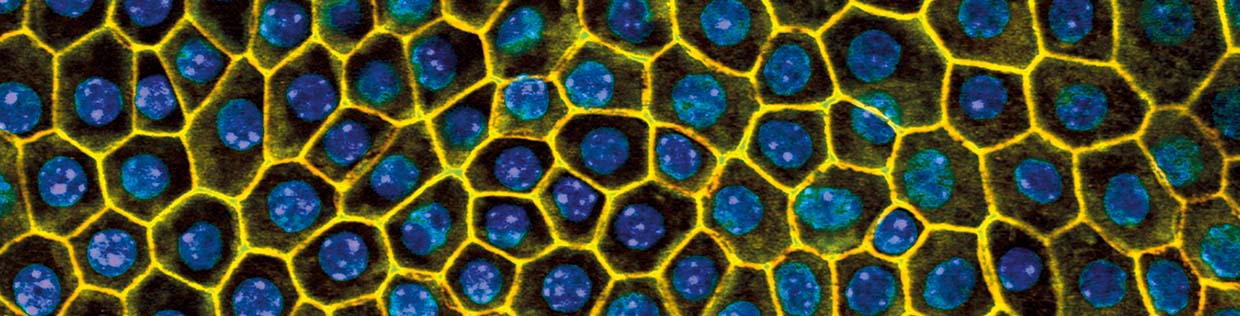

Advances in Optics & Photonics have always driven progress in many areas of biology and medicine. For example, biomedical photonic technologies are crucial for non-invasive clinical monitoring, molecular diagnostics, or imaging of physiological parameters in living cells, humans, and whole organisms. In addition, new optics-based tools have been engineered to manipulate biological systems by, e.g., laser-tweezers or light-switchable dyes and proteins for optogenetics. Regarding microscopy, several fluorescence-based microscopic techniques have been further developed and applied to image biological samples with sub-diffraction resolution. These techniques include pointillism approaches, like photoactivation localization microscopy (PALM), stochastic optical reconstruction microscopy (STORM), and structured illumination microscopy (SIM).
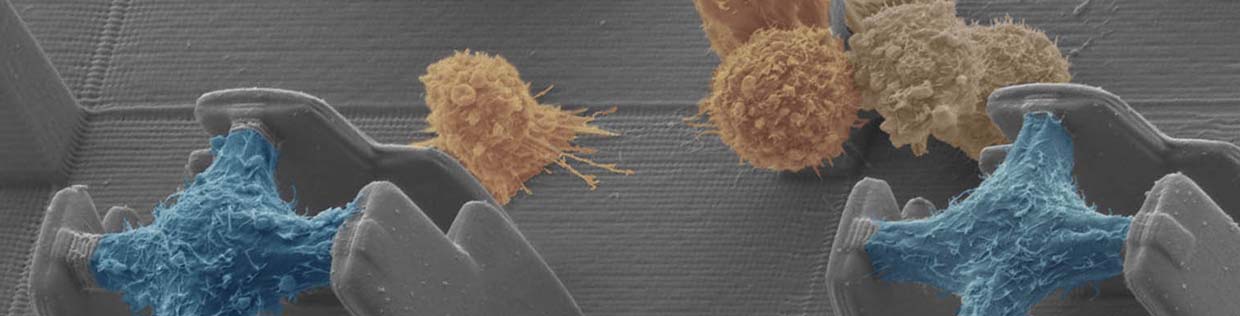
Research activities within KSOP span from advanced microscopy to the development of optics-based personal health monitoring. Super-resolution microscopic techniques are further developed into live-cell imaging modes. In addition, intelligent high-content screening microscopes for biological samples, e.g., zebra fish, are engineered. Furthermore, several optical methods for the detection and quantification of biomolecules are developed. These include ultra-sensitive micro-disk resonators, and other bio-functionalized nanophotonic structures for parallel detection in lab-on-a-chip applications (see Research Area IV). Moreover, non-invasive monitoring of essential human blood parameters such as pressure and glucose levels has been developed. Finally, direct laser writing (see Research Area I) is applied to fabricate three-dimensional ‘designer petri-dishes’ to study cell behavior and stem-cell differentiation.
Future Aims & Goals
With these novel multifunctional substrates, the effects of spatial ligand distributions and mechanical scaffold stiffness on cell behavior and stem-cell differentiation can now be systematically studied in three-dimensional environments. Further work in Research Area III aims at developing light microscopy super-resolution methods into live-cell imaging modes to study biomolecular interactions in living systems at the highest achievable spatial and temporal resolutions. The basic research activities on biomolecular sensing techniques chall be targeting the ultimate goal of label-free single-molecule detection.
Research Highlights
- Super-resolution Microscopy
- Optical Biosensing
- Tailored three-dimensional Scaffolds for Cell Culture
Participating Institutes and Research Groups
 |
Faculty of Chemistry and Biosciences Speaker of Research Area III |
 |
Biophotonics in the Life Sciences |
 |
Institute of Biomedical Engineering |

Do you want to study Optics & Photonics?
Learn More Here
Do you want to research in the field of Optics & Photonics?
Learn More Here